
Defining Woman as the Other
The Second SexThis thread follows the book’s opening inquiry from the unstable meaning of woman to its central claim that male-centered society makes woman the inessential Other.
increasing Bearing strength in each event
 decreasing
Bearing strength in each eventdecreasingThe Question of Woman

The Question of Woman
A disputed category
The book opens by asking what a woman is, surveying rival claims that femininity is an eternal essence, a bodily function, or merely a name. Each explanation seems to simplify a problem that remains unsettled in everyday life.
Beyond fixed definitions
Simone de Beauvoir rejects the idea that biology or an immutable feminine nature can define every woman. Yet she also refuses the abstract claim that women are simply interchangeable with men: each person lives from a concrete situation, and sex shapes that situation.
The inquiry begins
The question matters precisely because a man is rarely asked to define himself first as male, while a woman is repeatedly treated as a special case. The opening establishes the book’s task: explain how that asymmetry came to seem natural and what it does to women’s lives.
Man as Universal Subject

Man as Universal Subject
A one-sided relation
De Beauvoir argues that masculine experience has been treated as the human norm. Man can appear as both a particular sex and a supposedly neutral human being, while woman is defined in relation to him and marked as the sexed, limited other.
The Other without reciprocity
The category of the Other is widespread in human thought: groups define themselves against outsiders. But women have not been able to reverse the relation on equal terms or form an independent collective with comparable power.
The central asymmetry
This distinction gives the argument its central shape. Woman is not simply different from man; she is placed in a relation where he claims the position of subject and she is assigned the inessential position of object.
The Bond of Dependence

The Bond of Dependence
A group without separation
De Beauvoir asks why women, though roughly half of humanity, have not acted as a unified group that challenges male sovereignty. Women live dispersed among men and are tied to fathers, husbands, work, class, and racial divisions.
Complicity and advantage
The bond is not sustained by force alone. An alliance with men can offer material protection and social status, while the freedom to create one’s own aims brings uncertainty and risk. These advantages help explain why dependence can be accepted even when it restricts autonomy.
An unequal partnership
Men and women are necessary to one another, but necessity has not produced equality. The couple becomes a fundamental unit in which both halves are connected while one is granted sovereignty over the other.
Freedom Against Immanence
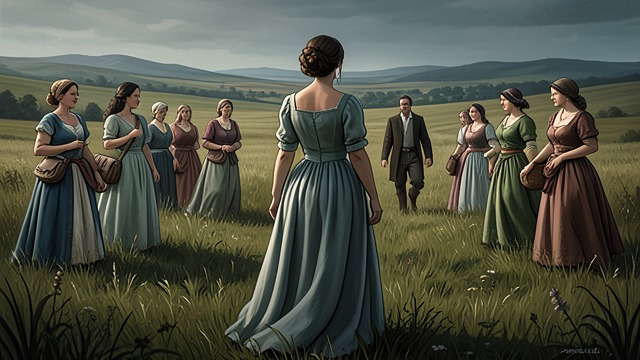
Freedom Against Immanence
A standard of judgment
The book adopts an existentialist perspective rather than measuring women’s condition by a presumed level of happiness. A human being becomes through projects that reach beyond the given; freedom is realized by acting toward an open future.
The imposed limit
Woman is an autonomous freedom, yet she discovers herself in a world that asks her to assume herself as Other. When her possibilities are blocked, transcendence is forced back into repetition and immanence.
The question carried forward
The conflict between her claim to act as a subject and the demand that she remain inessential frames the study that follows. The issue is not whether biology exists, but how society assigns it meaning and whether women can overcome the limits imposed on their freedom.
From Definition to Inquiry

From Definition to Inquiry
Three explanatory frameworks
Before tracing women’s history and lived experience, de Beauvoir examines biological data, psychoanalysis, and historical materialism. Each perspective contributes useful observations, but none can by itself explain why woman occupies a subordinate position.
Context gives meaning
The body, sexuality, and economic conditions matter only as they are taken up within a human situation. A physical difference does not carry a fixed social meaning; its significance depends on values, institutions, and available projects.
The book’s route
The argument therefore moves from inherited explanations to a historical account, then to the myths and daily experiences that shape femininity. The opening inquiry becomes a method: understand women through their situation without reducing them to fate.
Opening of Volume I
Early in the Introduction
Middle of the Introduction
Closing argument of the Introduction
End of Volume I Introduction
